The stack did not shrink, but the betting unit changed
A 200-unit stack in a 1/2 game contains 100 original big blinds. If an ordinary live straddle of four becomes the minimum amount to enter the pot, that same stack contains fifty straddle units. No chips disappeared. The unit used to describe the hand changed. Reading a 100-BB preflop chart without noticing that change can produce decisions intended for a much deeper game. Start by converting the effective stack before discussing ranges or raise sizes.
This article explains accounting for a conventional UTG straddle in a cash game. It does not assume that a particular online room offers the feature. House rules can change eligibility, order of action, minimum raises and whether later players may re-straddle. Button and Mississippi arrangements need their own review. The examples below specify their amounts and use no solver output or hand-history sample. They show what follows from the numbers, rather than declaring a profitable strategy.
Identify the live blind before using a chart
A conventional straddle is an extra blind posted before looking at the cards. Under the assumed rules, it gives the straddler a later preflop action and sets a higher amount for players entering the pot. Those details must be confirmed at the table. A voluntary blind bet made after seeing a hand, an ante paid by everyone and a regular opening raise are different actions. Their accounting and action order should not be merged under the same label.
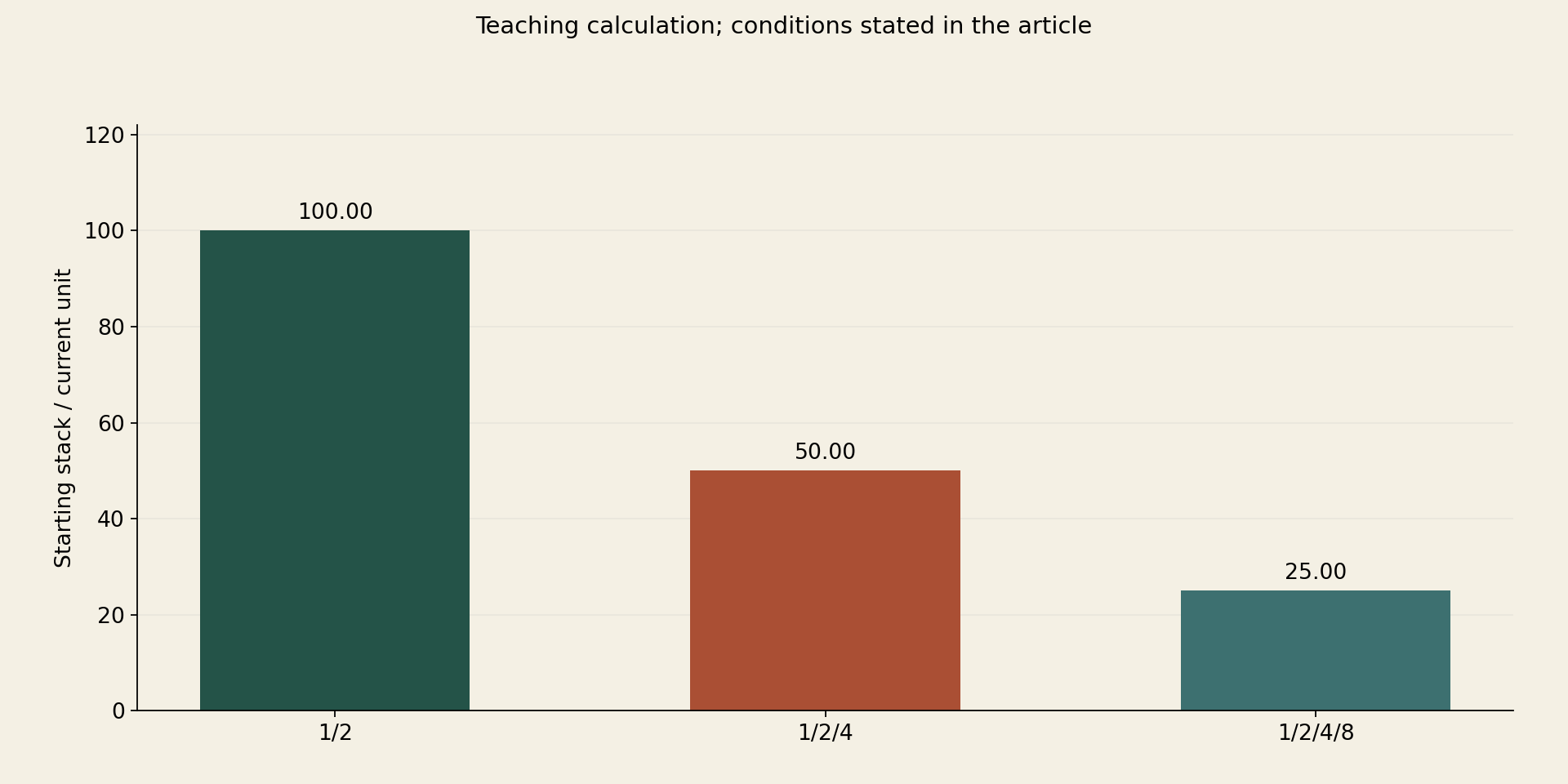
For our first example, the small blind is one, the big blind two and the straddle four. The unopened pot is seven units: 1 + 2 + 4. A 200-unit effective starting stack is 100 old big blinds or fifty straddle units. A re-straddle of eight would make it twenty-five current units, if those rules permit it. This conversion says nothing about the correct opening range; it tells you which depth assumption a range would have to match.
| Posted extra blinds | Current unit | Starting stack / current unit | Unopened pot |
|---|---|---|---|
| 0 | 2 | 100.00 | 3 |
| 4 | 4 | 50.00 | 7 |
| 4 + 8 | 8 | 25.00 | 15 |
Effective means the smaller relevant stack
Suppose you have 400 units and a particular opponent starts with 200. Against that player the effective starting depth is 200, so a four-unit straddle makes it fifty units of the current blind. Your larger personal stack does not make that confrontation 100 straddle units deep. In a multiway pot, different opponents can have different effective depths. Side pots and unequal commitments require player-specific accounting rather than one number pasted over the entire table.
Use a consistent time reference as well. Starting-stack depth and the money left after posting a blind are not identical quantities. A player starting with 200 who posts four has 196 behind. Calling the hand fifty straddle units deep describes the starting amount; the remaining amount is forty-nine such units. Both can be useful, but switching between them mid-example causes unexplained discrepancies. Record whether a calculation uses the starting stack or the stack remaining before the decision.
Count all dead money once
Take two players who have not posted a blind. Each starts with 200. One opens to twelve, the other calls twelve, and the small blind, big blind and straddler fold. The flop pot is 12 + 12 + 1 + 2 + 4 = 31 units before rake or other deductions. Both remaining players have 188 behind. The starting flop stack-to-pot ratio is therefore 188 / 31, about 6.06. Do not count the four-unit straddle again as a separate additional call.
If the caller had instead been the straddler, that player would add eight to reach twelve, not another twelve. With the other blinds folding, the flop pot would be 12 + 12 + 1 + 2 = 27, and both players would still have 188 behind. The ratio would be about 6.96. This is why hand examples should name who posted which blind. A diagram that only lists “raise, call, blinds” leaves room for a double-counted straddle.
| Caller | Flop pot | Stack behind | SPR |
|---|---|---|---|
| Player outside blinds | 31 | 188 | 6.06 |
| Straddler | 27 | 188 | 6.96 |
“Three times the blind” needs an explicit unit
In a 1/2/4 game, an open to twelve is six original big blinds but three straddle units. An open to six is three original big blinds but only 1.5 straddle units. Whether six is a legal full raise depends on the table's rules; this article does not declare it valid merely because it fits an old chart. Write both the currency amount and the unit when comparing sizes. A bare label such as 3 BB becomes ambiguous after the live blind changes.
Do not solve that ambiguity by multiplying every range and size mechanically. A larger unopened pot can change incentives, while a smaller effective depth can change the consequences of later raises. The appropriate strategy also depends on position, number of players, rake, opponents and allowed actions. Our examples do not estimate those effects. They provide a clean accounting base for a rule-matched analysis and prevent an ordinary unit conversion from being presented as a complete strategic solution.
The straddler's preflop option does not erase position
Under a conventional live UTG straddle, the straddler may receive a later decision before the flop. That does not move the seat to the button for subsequent streets. Confirm the actual action order before describing a positional advantage. Different straddle variants can alter the order in different ways, and a statement about one arrangement should not be carried across to every game that uses the word. Table-specific rules are part of the hand, not a footnote to add afterwards.
Being allowed to post voluntarily also does not establish positive expected value. The contribution is made before the cards are known and changes the amount exposed to the hand. We have not measured any compensating effect from a particular lineup or social arrangement. A fixed spending plan should count the extra blind as wagering exposure. If the resulting stakes no longer fit that plan, reducing exposure or choosing another game is more defensible than assuming the extra option makes the cost disappear.
Use the same units when tracking a session
Track the actual monetary result first. If you additionally report results in big blinds, state whether the denominator is the original big blind or the current live blind. Winning twenty units in a 1/2/4 game equals ten original big blinds or five straddle units. Neither description is a different amount of profit. Comparing two sessions using different denominators without disclosure can make an unchanged monetary performance appear to improve or decline sharply.
The same discipline applies to a budget expressed as “buy-ins”. A 200-unit starting amount remains 200 units, but is not the same depth relative to a two-unit and a four-unit live blind. We do not prescribe a universal bankroll multiplier for straddled games. Expected return, variance, stakes and personal affordability are separate inputs. A simple depth table cannot establish a risk-of-ruin percentage or justify increasing the money available for play.
What this guide adds to the existing material
The glossary defines the term; the preflop framework explains general decision structure; the open-raise guide discusses sizing. Here the focus is the arithmetic that connects them when an extra live blind changes the hand. The calculation file reproduces unit conversions, final contributions and stack-to-pot ratio. It contains no private hand histories, observed win rates or claim that the proposed sizes are solver-approved. The numbers can be checked without assuming any particular cards or opponent strategy.
Before playing a straddled hand, identify the applicable rule, convert the effective depth, count the unopened pot and express any raise in explicit units. Then use strategic guidance that actually matches the resulting setup. If the room uses another straddle variant, record the difference and redo the accounting. The useful result is a hand described accurately enough to analyze, rather than an attractive range chart applied to the wrong game depth.